

23 February 2022
Tenant power: digging for victory
Tina Harrison MBE
Six Town Housing tenant volunteer
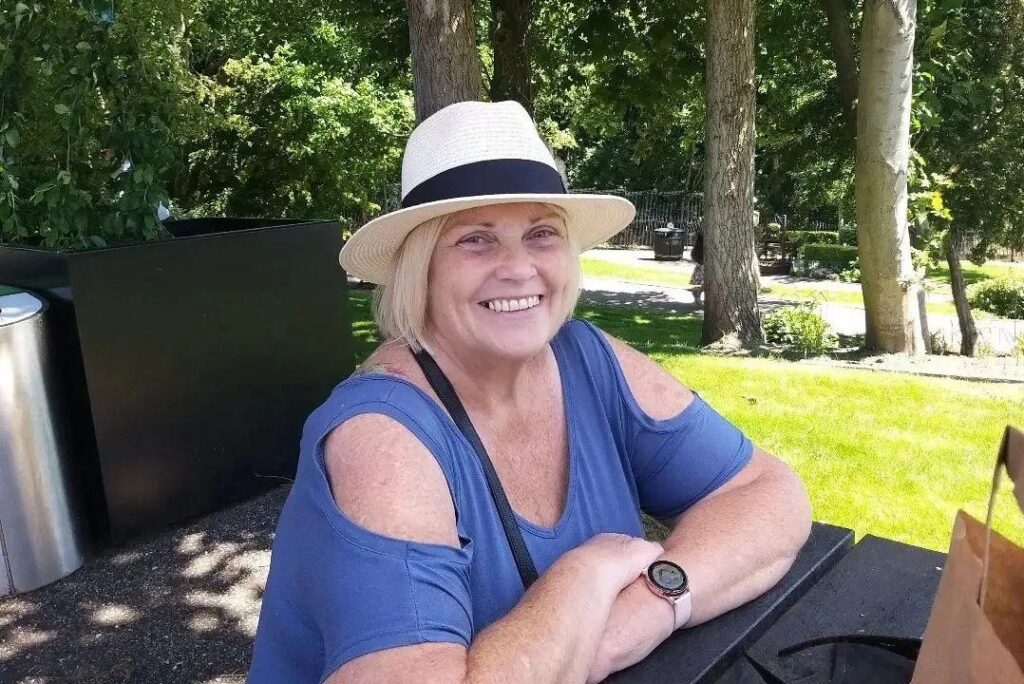
Tina Harrison is a founder member of Bury’s Corrie Gardeners, a ground-breaking tenants’ group in every sense; they’ve turned the turf around the Coronation Garden blocks into a jewel of a communal garden and, on the way, transformed and enriched community life. Tina’s neighbours and fellow gardeners wanted to celebrate her vision and inspiration, the driving force behind this achievement, and during lockdown she was nominated for an MBE. She hopes the honour will inspire other ALMO residents to believe that it really is possible to kickstart change in their own communities.
When you moved to Coronation Gardens in Bury 12 years ago, why did you decide to do much more than just get to know your new neighbours?
Although I’m a state registered nurse, osteo-arthritis had left me unfit for the physical demands of the job. I had to find something to do with my time.
People in Coronation Gardens were so welcoming when we arrived. I can honestly say that I’ve never regretted moving here, not for a moment. Very rapidly I realised that whenever anything’s needed, the community spirit comes out even though people here are far from well-off.
At first I joined the local tenant representatives association but that seemed to be mainly about getting services to older people. There was a gap, I felt, around reaching younger people and those with often complex needs – for instance, people struggling with substance misuse or mental health problems, or young families who needed some support.
I started in a small way, when the landlord suggested paving around the base of the flats to make maintenance easier. I thought we could do better than that – invite nature in with flower beds instead while also protecting the privacy of people living in ground-floor flats. I got out there to make a start with a few neighbours and people of all ages began talking to us as they passed.
It became evident that people wanted to socialise. So we had a few events; a barbecue or sometimes an afternoon tea, or an Easter egg hunt and a few activities in the summer holidays for the children. We don’t have a community centre here, so everything has to be outside and we’ve just made the best of what we have.
We try to think about all the people who are part of our community. For instance, we have veterans and asylum seekers among our neighbours, so it’s light shows instead of fireworks here. It’s about thinking fluidly and adapting as we realise that there’s some problem we should address.
We all need to work together for a better community – even as tenants, not least because we know the place and people better than anyone.
Community volunteering can take up a lot of time, work and effort – is it worth it?
There will always be some residents who have issues and problems but, you know, they still need a roof over their head. A lot of our properties are one-bedroom flats, so clearly among those residents will be people who have been isolated by life events or mental health problems.
I always want to ask whether we, as tenants, can be an advocate for that person? Can we be the more approachable person, the one without a lanyard? Obviously some problems may be too complex for us, but there are times and places when we might be the right kind of mediator. The point is that we all need to work together to deliver a better community, and even as tenants we have a real part to play, not least because we live here and know the place and the people better than anyone.
Do you ever despair about whether some are beyond help?
Everybody should have an opportunity to be the best person they can be. And even if they fall at the first hurdle, we should help them back up again. So, for instance, we have this one young person who managed to stop substance abuse during COVID, partly because of our support. We dropped off food and regularly chatted through the window, just letting this person know that we were there. Then we helped them access a mental health course. Now they are trying to help others; volunteering for suicide prevention initiatives as a local mental health champion, helping at the food bank, helping at our regular veterans’ breakfasts.
That speaks volumes, doesn’t it? Just seeing someone supporting the community that supported them makes me more determined than ever that we make sure others get that chance to be a better person. These are the type of people you really want in your community. Even if you’ve only had one success out of 10 people or 20 people, that one person is enough.
Are there other lives you’ve seen change because their community was able to help?
A resident came to our support group one day last year when we were in the middle of COVID. He was visibly shaking. He eventually told us that he’d spent 20 years in and out of prison since he was a teenager. That day he was due to sign for his tenancy and he was terrified – he didn’t even know if he wanted it. He’d never had a place of his own in his life, he’d never paid a bill, he had no idea how to budget. Sofa-surfing was all he knew how to do.
We talked him into going to get the keys and then got him in touch with a tenancy sustainment officer from Six Town Housing who helped him sort out bills and budgets and a bank account – something else he’d never had before. We told him we’d support him, we’d help him get a bit of furniture. We did all that and now, nearly two years down the line, he has a home and a dog. He’s even found a girlfriend. And he’s not back in prison.
We wanted to create a place where older people could engage with the younger community and really build up that trust that’s gone missing between the generations.
It can’t all have been plain sailing …
Well, we did learn to live with plants being stolen from the flower beds because we found the more we broadcast how terrible it was, the worse it got. When we changed to thinking ‘well, we’ll just quietly put another plant in’, nothing happened. The attention was gone, the plants stopped disappearing.
Part of the point of the community garden was making a place where older people could engage with the younger community and really build up that trust that’s gone missing. I wanted to work out how we could move on from the first thought many of us have, that children are just there to cause problems. Many of our youngsters have had difficult lives and many are the second or third generation in their families really struggling with life problems.
Last year we put a friendly bench in the community garden. As you can imagine, within the first two weeks a few local youngsters had drawn all over it. My husband simply cleaned it up. Our local community police officer had a gentle word with some of the youngsters. It stopped.
When older neighbours started to worry about the seat being a magnet for teenagers at night, we spoke to the youngsters. They just wanted a nice place to meet up – there was nowhere else quite like it locally. And now the older people say hello and ask how they are as they go by. It’s all about mutual trust.
What about your MBE – how do you feel about it?
The email about the MBE came through when I was doing my shift at the food bank and I thought ‘Oh, that’s a good joke.’ When I read it again in the evening, it looked quite official and I thought, these people seem to know a lot about me – maybe it’s real. It’s been a surprise, but it’s also been wonderful, though I would have preferred it to have been a group honour. Since we can’t quite do it that way, I’ve accepted it for all the volunteers, not just for myself. We’re a team.

Tina (foreground, white top) at the socially-distanced handover of the Corrie Gardens friendly bench last spring.